One of the most common questions asked when purchasing a fiberglass reinforced plastic chemical storage tank is simple: How many years will it last?
The difficulty is that there is no single number that accurately describes the FRP tank service life of every tank.
Consider two tanks with similar dimensions and capacity. One stores a salt solution at ambient temperature, while the other continuously contains a hot acid solution or a chemically complex process mixture. From the outside, the two vessels may look nearly identical, but the materials inside them are working under very different conditions. Their actual service lives may therefore be very different.
For this reason, the age of a tank alone tells only part of the story. A more useful question is:
What operating conditions has the tank experienced throughout its life?
Chemical exposure, temperature, resin selection, corrosion-barrier construction, structural loading, fabrication quality, installation, and maintenance all influence how quickly an FRP tank changes over time.
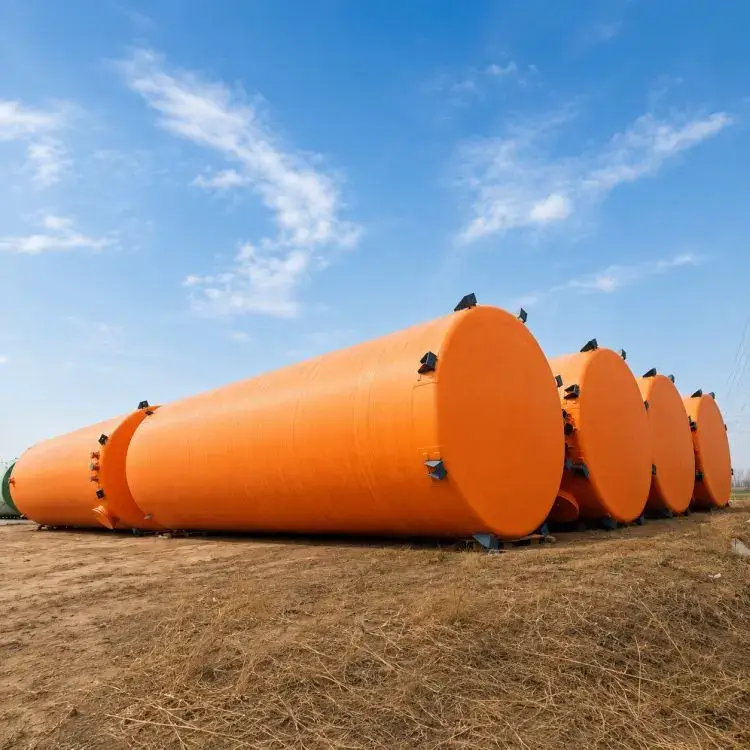
FRP is widely selected for corrosive service, but “corrosion resistant” does not mean that every FRP construction is suitable for every chemical.
The material in direct contact with the stored liquid is the resin-rich corrosion-resistant laminate. Different resin systems respond differently to acids, alkalis, salts, oxidizing chemicals, and organic solvents.
Even when the chemical itself remains the same, a change in concentration can alter long-term material behavior.
For that reason, the original design of an FRP chemical tank should normally consider information such as:
chemical name and composition;
normal concentration and possible concentration range;
pH, where relevant;
normal and maximum operating temperature;
liquid density or specific gravity;
possible oxidizers, solvents, chlorides, or other contaminants;
chemicals used during cleaning or maintenance.
This last point is easy to overlook.
A tank may have been designed for one process liquid, yet over the years it may be exposed to different raw materials, revised formulations, cleaning chemicals, or process contaminants. Changes that seem minor from an operational perspective may be significant from a materials perspective.
When evaluating an existing chemical tank, it is therefore useful to ask not only what is stored today, but also what has been stored in it over time.
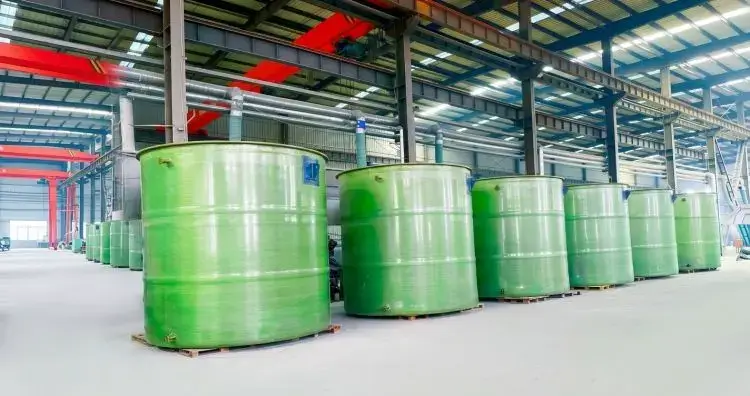
Chemical compatibility and temperature should rarely be evaluated separately.
A resin system that performs well with a particular chemical at ambient temperature may behave differently when the same liquid is continuously stored at an elevated temperature.
Higher temperatures can increase molecular diffusion, accelerate chemical reactions, and increase the rate of material aging.
For this reason, tank specifications should distinguish between several different temperature conditions:
normal continuous operating temperature;
higher temperatures that may occur for extended periods;
short-term maximum or upset temperature;
temperatures encountered during cleaning or flushing.
A tank that normally operates at 40°C, for example, should not automatically be assumed to tolerate repeated exposure to substantially hotter cleaning liquid simply because the exposure is temporary.
When a tank operates close to the upper temperature limit of its resin system, resin selection, corrosion-barrier construction, curing quality, and process control become even more important.
So when estimating service life, the question should not simply be “What chemical is stored?”
It should be:
“What chemical, at what concentration, and at what temperature?”
The wall of a chemical storage tank is not usually one uniform material performing one function.
The liquid-contact side is designed primarily for chemical resistance and permeation control. Behind it, the structural laminate provides strength and stiffness. The outside surface protects the structure from weathering and the surrounding environment.
This means that total wall thickness alone does not fully describe long-term corrosion resistance.
Two tanks can have the same overall wall thickness but very different corrosion-barrier constructions, resin systems, reinforcement materials, and expected performance.
The inner corrosion-resistant region may include a resin-rich surface and selected reinforcement layers designed to separate the stored chemical from the higher-glass-content structural laminate.
Over time, changes may first appear at the liquid-contact surface. These may include:
loss of gloss;
discoloration;
surface roughening;
localized resin attack;
minor surface wear.
Such changes do not automatically mean that the tank has lost structural integrity.
They should, however, be treated as useful indicators of how the material is responding to service.
The more serious situation is when chemical attack progresses beyond the intended corrosion-resistant region and begins to affect the structural laminate. At that point, the issue is no longer limited to appearance or surface degradation.
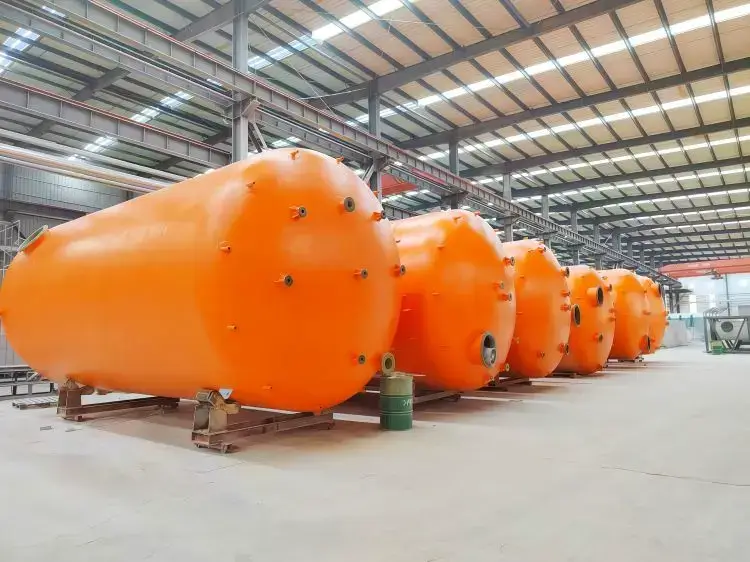
Correct material selection is only part of the equation.
FRP is a process-dependent composite material. Resin, glass fiber, and reinforcement have to be combined through controlled wet-out, lay-up, winding, consolidation, and curing to create the intended laminate.
If those processes are not properly controlled, weaknesses can remain inside the structure even when the finished tank looks acceptable from the outside.
For example, poor fiber wet-out can leave dry areas. Entrapped air and voids may create paths for chemical penetration. Inadequate preparation between laminate stages can weaken secondary bonding, while insufficient cure can reduce both chemical resistance and mechanical properties.
Manufacturing conditions can influence the final laminate in several ways. Important variables may include:
resin condition and temperature;
ambient temperature;
fiber tension;
laminate thickness per application stage;
curing time;
curing temperature;
workmanship during consolidation.
This is why service life begins to be influenced long before the tank receives its first batch of chemical.
A tank cannot rely on good resin selection to compensate for poor fabrication.
Chemical exposure is only one part of the environment experienced by a storage tank.
During operation, the structure also has to withstand hydrostatic pressure, its own weight, environmental loading, and forces transferred from connected equipment and piping.
For a large vertical tank, hydrostatic pressure is greater near the bottom of the shell than near the top. Structural laminate design therefore has to reflect the actual load distribution rather than simply applying one wall thickness everywhere.
External piping is another common source of overlooked loading.
If connected piping is poorly supported, the tank nozzle may be subjected to:
pipe weight;
valve weight;
thermal movement;
installation misalignment;
vibration;
forces from connected equipment.
These loads may not cause immediate leakage, but they can create long-term stress concentrations around the nozzle or shell.
Mixers, ladders, platforms, large flanges, and other attachments also influence structural behavior.
A tank that was never designed to support a mixer should not simply have one added later without reviewing the new load path.
In other words, tank life depends not only on what happens inside the vessel, but also on what is continuously acting on the outside.
Large FRP tanks depend on proper support.
A flat and stable foundation allows the tank bottom and shell to carry loads in the way they were designed to.
If the foundation is uneven or experiences differential settlement, additional deformation can develop in the tank bottom and lower shell.
The difficult part is that this kind of problem may not cause an immediate failure.
A vessel may operate for years while gradually experiencing redistribution of stress. Eventually, damage may appear around the bottom, shell transition, nozzles, or other localized areas.
For this reason, installation inspection should consider more than whether the tank appears level on the first day.
Useful checks include:
foundation condition;
abnormal settlement;
tank inclination;
anchoring condition;
pipe loads at nozzles;
movement of supports or surrounding structures.
If a tank remains under unintended stress for a long period, its long-term performance may be affected even when the chemical environment itself has not changed.
An outdoor chemical tank has to deal with more than the liquid inside it.
Sunlight, rain, temperature cycling, atmospheric contamination, and humidity all act on the outside surface.
Long-term ultraviolet exposure may lead to surface fading, loss of gloss, chalking, or other weathering effects. Coastal installations may combine high humidity, salt-laden air, and strong sunlight.
This is why the exterior resin system and weather-resistant surface treatment matter.
Depending on the project, the outer surface may incorporate UV-resistant additives, pigments, coatings, or other protective measures intended to slow environmental aging.
One distinction is important:
Surface discoloration does not automatically mean structural failure.
The condition of the tank should be evaluated together with cracking, delamination, deformation, exposed reinforcement, and the condition of the internal corrosion-resistant laminate.
Appearance is one piece of evidence, not the complete diagnosis.
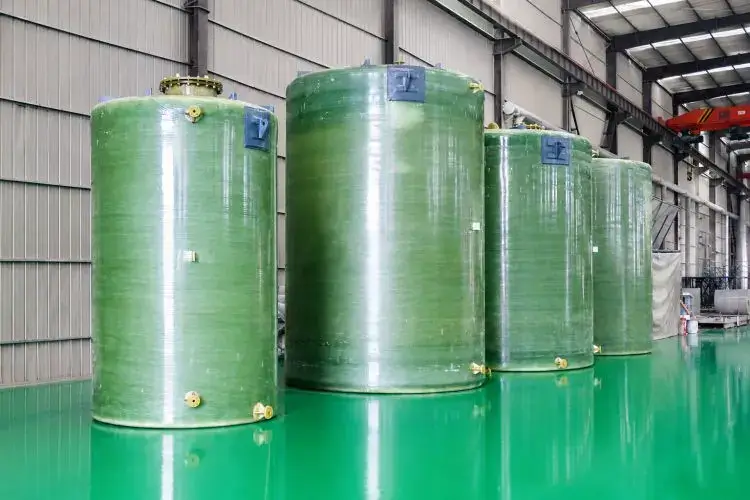
Every tank is designed around a set of assumptions.
If those assumptions change during operation, the original material and structural design may no longer represent the actual service.
Common changes include:
switching to a different stored chemical;
increasing chemical concentration;
raising the continuous operating temperature;
adding a mixer or circulation system;
changing the cleaning method;
adding platforms, valves, or other equipment;
rerouting external piping and increasing nozzle loads.
None of these changes automatically means that the tank must be taken out of service.
They do mean that the original design conditions should be reviewed.
One of the more serious risks in long-term equipment operation is not simply that a tank gets older. It is that the process changes while the tank continues to be treated as if nothing has changed.
FRP tanks do not usually change from “acceptable” to “failed” on a particular anniversary.
Material condition develops gradually.
That is why inspection is more useful than relying only on calendar age.
Routine and planned inspections can look for conditions such as:
blistering, cracking, softening, or abnormal attack on the internal surface;
external cracks, impact damage, or deformation;
leakage or cracking around nozzles and flanges;
abnormal contact between the tank bottom and foundation;
excessive piping loads;
movement around supports or anchors.
For older tanks, hazardous chemical service, or equipment that has experienced major operating changes, more detailed assessment may be appropriate.
The inspection method should be selected according to the tank design, service conditions, and the type of deterioration being investigated.
Not every visible change has the same meaning.
Minor cosmetic discoloration is very different from deep cracking or widespread delamination.
Conditions such as the following deserve more careful evaluation:
continuous leakage;
obvious delamination;
deep structural cracks;
severe blistering;
significant nozzle deformation;
widespread material softening.
A tank should not continue operating simply because it has not yet reached an expected number of years.
Equally, an older tank that remains in good condition and has consistently operated within its design limits should not be judged only by age.
The most accurate answer is:
There is no universal service-life number that applies independently of the operating conditions.
The main factors can be viewed as one connected chain:
Chemical environment → Temperature → Material selection → Corrosion barrier → Structural design → Fabrication quality → Installation → Operation → Inspection and maintenance
A serious weakness in any one of these areas can reduce the actual service life.
The reverse is also true.
When the resin system is properly selected, the laminate is correctly designed, fabrication quality is controlled, installation is appropriate, and the tank remains within its intended operating envelope, long-term service becomes much more achievable.
This is a more useful way to think about FRP tank service life than assigning one fixed number of years to every vessel.
Many of the factors that influence tank longevity can be controlled during the procurement and design stage.
The more accurately the operating conditions are defined, the more meaningful the material and structural design can be.
A useful technical inquiry should normally include:
chemical composition;
concentration;
normal operating temperature;
maximum temperature;
liquid density;
working capacity;
pressure or vacuum conditions;
installation location;
major nozzle requirements;
unusual or upset operating conditions.
Future changes should also be considered where possible.
If the process is likely to require a mixer, heavy valve, platform, large nozzle, or other external load later, including that information at the design stage is much better than modifying the tank after installation.
For Yingnai, a chemical storage tank is not simply selected by volume and matched to a standard wall thickness. Material system, corrosion barrier, structure, and accessories are developed around the actual service conditions of the project.
Reliable service life is therefore not created by promising an attractive number of years.
It is created by keeping material selection, structural design, fabrication quality, installation, and actual operation aligned with the same engineering basis over time.

 English