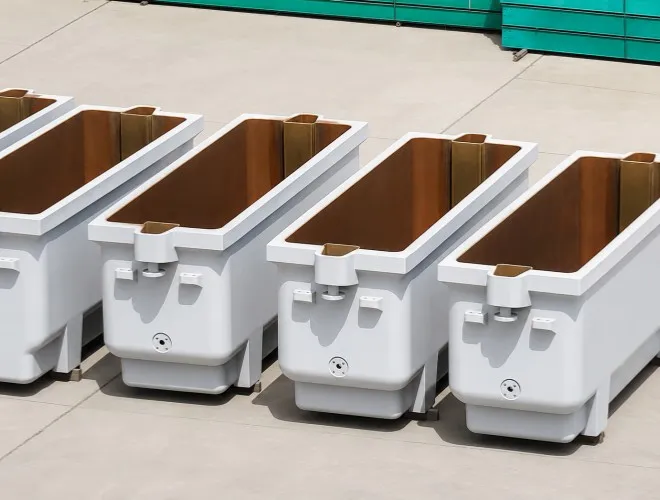
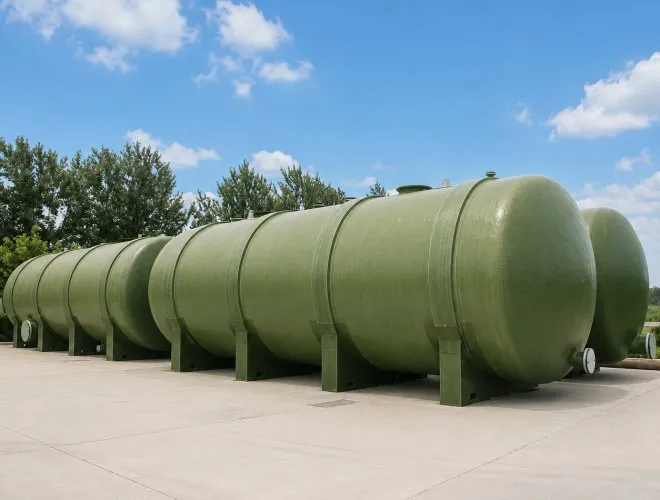
Yingnai FRP pickling tank is engineered as a corrosion-resistant electrolytic cell for electrowinning and electrorefining operations. Its monolithic vinyl ester resin composite structure provides high strength, dimensional stability and electrical insulation, supporting accurate electrode spacing and reliable tankhouse operation. Cell dimensions, overflow arrangement, interfaces and reinforcement can be customized for specific electrolyte and process requirements.


| Parameter | Typical / Reference Specification |
| Product Name | FRP / Polymer Concrete Electrolytic Cell |
| Reference Product Type | Vinyl Ester Resin Cast Electrolytic Cell |
| Main Applications | Electrowinning and electrorefining of copper, zinc, nickel, cobalt, manganese and other non-ferrous metals |
| Structural Form | Monolithic cast construction |
| Typical Structural System | Internal FRP corrosion barrier, vinyl ester polymer concrete structural core and external FRP protective layer |
| Binder Resin | Bisphenol-A vinyl ester resin; novolac vinyl ester resin available for more demanding chemical service |
| Aggregate | Graded quartz sand, silica sand and selected mineral fillers |
| Reinforcement | FRP reinforcing ribs, FRP rebar or localized composite reinforcement according to structural design |
| Design Pressure | Atmospheric pressure |
| Reference Overall Dimensions | 4,630 × 995 × 1,570 mm |
| Reference Effective Internal Length | Approx. 4,240 mm |
| Reference Internal Width | Approx. 820 mm at the upper section |
| Estimated Working Capacity | Approx. 4–5 m³ for the reference cell, depending on operating liquid level and internal configuration |
| Overflow Connection | DN100 reference size; customizable |
| Electrolyte Inlet and Drain | Customized according to the tankhouse piping arrangement |
| Internal Baffles | Optional Type 1, Type 2 or project-specific flow-guiding baffles |
| Recommended Continuous Operating Temperature | Normally up to 80°C, depending on electrolyte composition and resin selection |
| Maximum Temperature Capability | Up to approximately 100°C with a suitable resin system and chemical compatibility verification |
| Typical Compressive Strength | ≥100 MPa |
| Typical Flexural Strength | ≥20 MPa |
| Typical Material Density | 2.1–2.3 g/cm³ |
| Water Absorption | ≤0.5% |
| Linear Shrinkage | ≤0.35% |
| Key Internal Dimensional Tolerance | Typically within ±3 mm |
| Diagonal Tolerance | Typically ≤5 mm |
| Verticality Tolerance | Typically ≤5 mm |
| Electrical Property | Electrically insulating and non-conductive compared with metallic cells |
| Magnetic Property | Non-magnetic |
| Internal Surface | Smooth, resin-rich and corrosion-resistant surface |
| External Surface | Sealed FRP protective finish or customized protective coating |
| Typical Electrode Spacing | Approximately 90–110 mm, subject to electrode and process design |
| Electrode Quantity | Customized according to cell length, electrode dimensions and spacing |
| Reference Design Service Life | 20–30+ years under specified operating conditions |
| Installation Method | Floor-supported installation on a level and continuous foundation |
| Standard Colour | Light grey or customized |
| Optional Components | Overflow outlet, drain connection, internal baffles, capping-board supports, electrode positioning interfaces and lifting provisions |
| Inspection and Testing | Raw-material inspection, dimensional inspection, surface inspection, curing verification and water-fill leakage testing |
| Applicable Test References | ASTM C579, ASTM C580, ASTM C307, ASTM C413, ASTM C531, ASTM D2583, ASTM C581 and ISO 175, where applicable |
| Customization | Dimensions, resin system, structural thickness, reinforcement, electrode arrangement, interfaces, baffles, colour and installation details |
 English