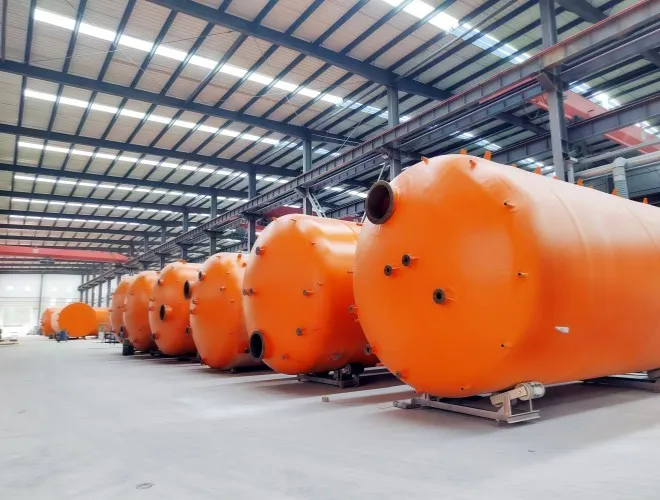
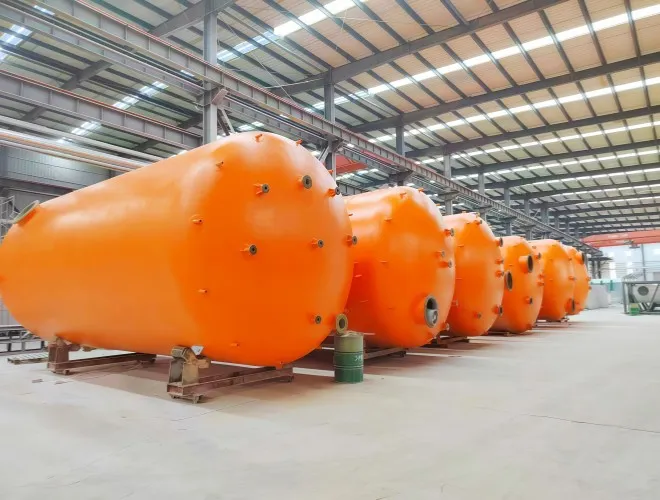
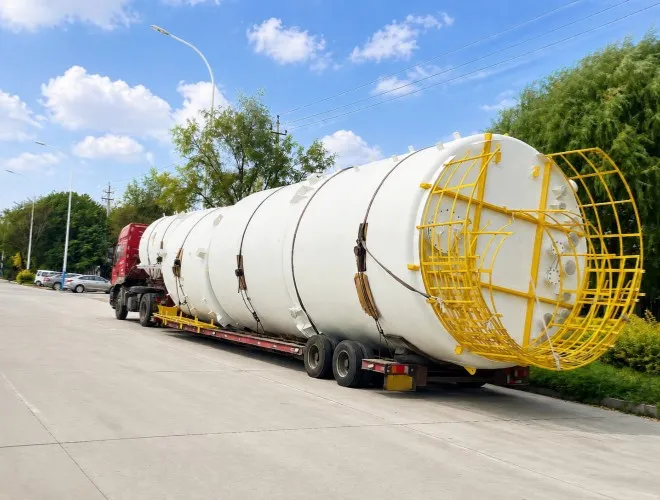
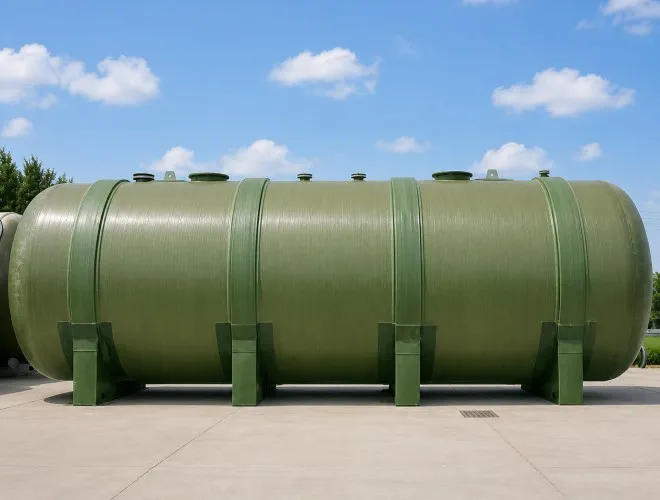
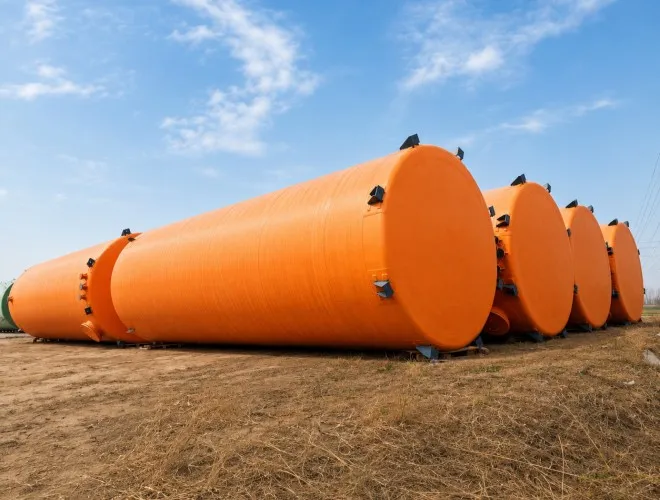
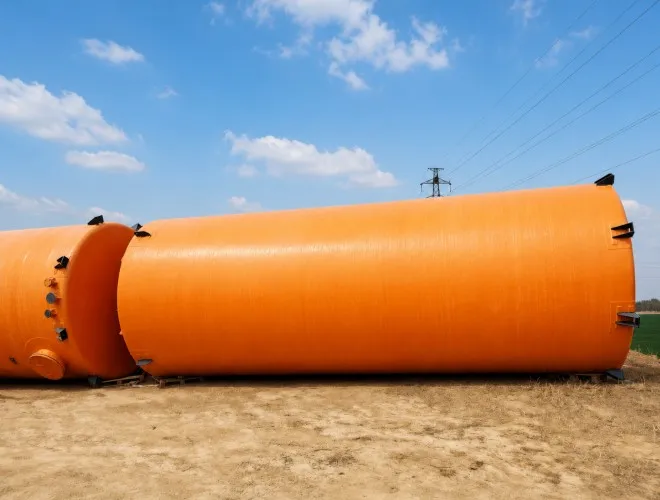
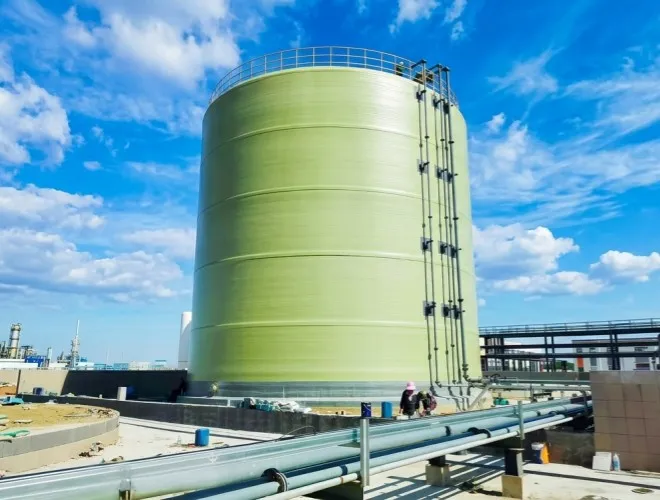
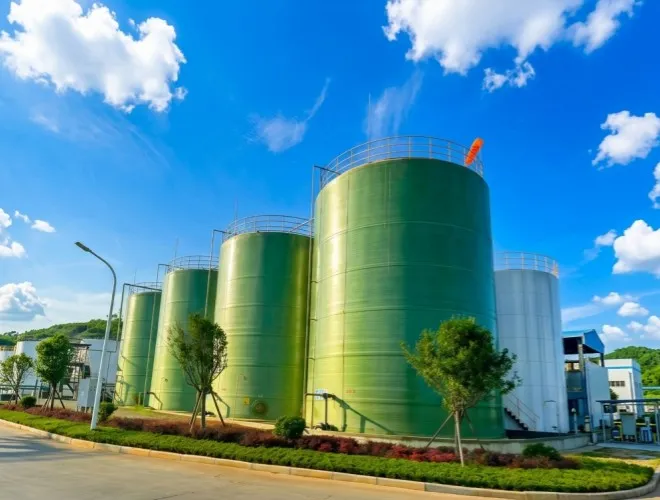
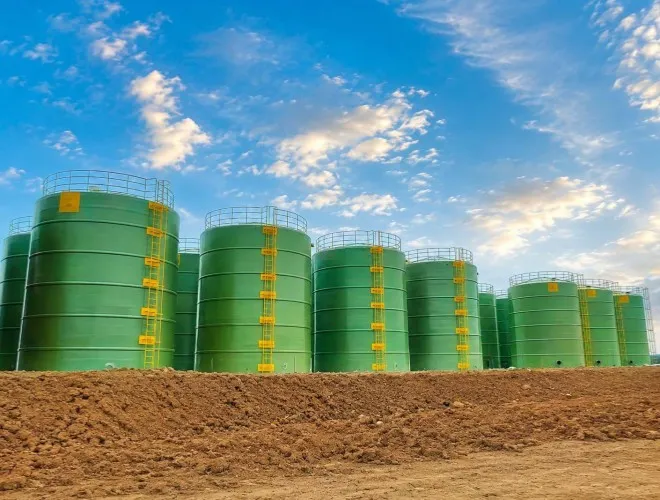
When the diameter, capacity, or overall dimensions of an large FRP tank exceed conventional transportation limits, manufacturing the entire vessel in a factory and shipping it as one piece is often no longer the most practical solution. In such cases, field fabrication becomes an important option for large industrial storage projects.
On-site fabrication, however, is not simply a matter of moving factory work outdoors. A large FRP storage tank involves material selection, corrosion-resistant construction, structural design, foundation preparation, environmental control, dimensional accuracy, lifting conditions, curing, and quality inspection.
This is especially important in chemical processing, metallurgy, water treatment, mining, and other industrial applications where the tank may remain in contact with corrosive liquids for many years.
To understand how a large FRP tank is manufactured and installed on site, it is useful to start with a more basic question:
Why manufacture the tank at the project site in the first place?
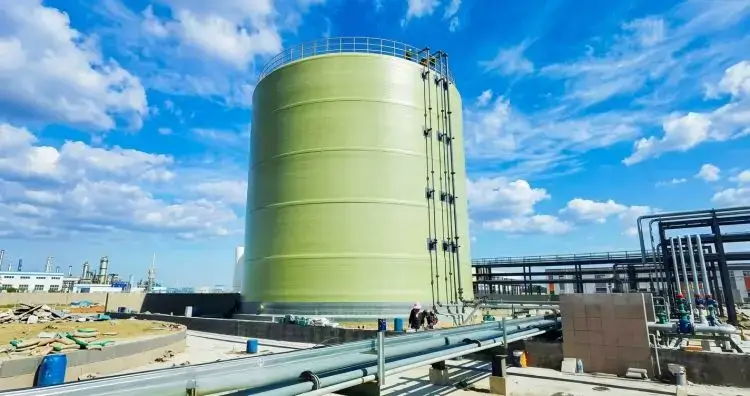
Factory fabrication offers clear advantages. Temperature and humidity can be controlled more easily, manufacturing equipment is permanently available, raw materials can be managed under stable conditions, and inspection is easier to organize.
As tank size increases, however, transportation can become the limiting factor.
A very large vessel may exceed practical limits related to:
road width and turning radius;
bridge clearance;
transportation height and width restrictions;
port or crane capacity;
access roads inside the project site;
nearby buildings, pipe racks, or other structures.
At that point, transporting the completed tank may become more complicated than manufacturing it at its final destination.
Depending on the project, several construction strategies can be used. A tank may be fabricated almost entirely on site, major sections may be prefabricated and assembled at the project location, or factory-made components may be combined with field-fabricated shell and bottom sections.
The right approach depends on tank diameter, height, capacity, site location, available workspace, and transportation conditions.
A field erected FRP tank should therefore be understood as a project-specific manufacturing strategy rather than one fixed fabrication method.
Before resin or glass reinforcement is applied, the project site itself has to be ready.
For a large storage tank, foundation quality affects how the vessel will carry loads throughout its service life. The support surface must provide the required flatness, strength, and long-term stability.
Uneven support or differential settlement can introduce stresses that were not part of the original tank design.
The fabrication area also needs to provide enough working room for materials, tools, lifting equipment, temporary structures, and personnel.
Before fabrication begins, several conditions should normally be confirmed:
Is there sufficient working space around the tank location?
Can resin, reinforcement, and auxiliary materials be stored in dry and protected conditions?
Are ambient temperature and humidity suitable for fabrication and curing?
Is there enough access for winding, lifting, scaffolding, and temporary equipment?
Are electrical supply, lighting, and site safety systems available?
Weather becomes particularly important for outdoor fabrication.
Wind can interfere with reinforcement placement. Rain and high humidity can affect bonding and curing. Very low or very high temperatures can change resin viscosity, working time, and cure behavior.
For this reason, temporary enclosures, rain protection, dust control, ventilation, heating, or other environmental measures may be required depending on the site.
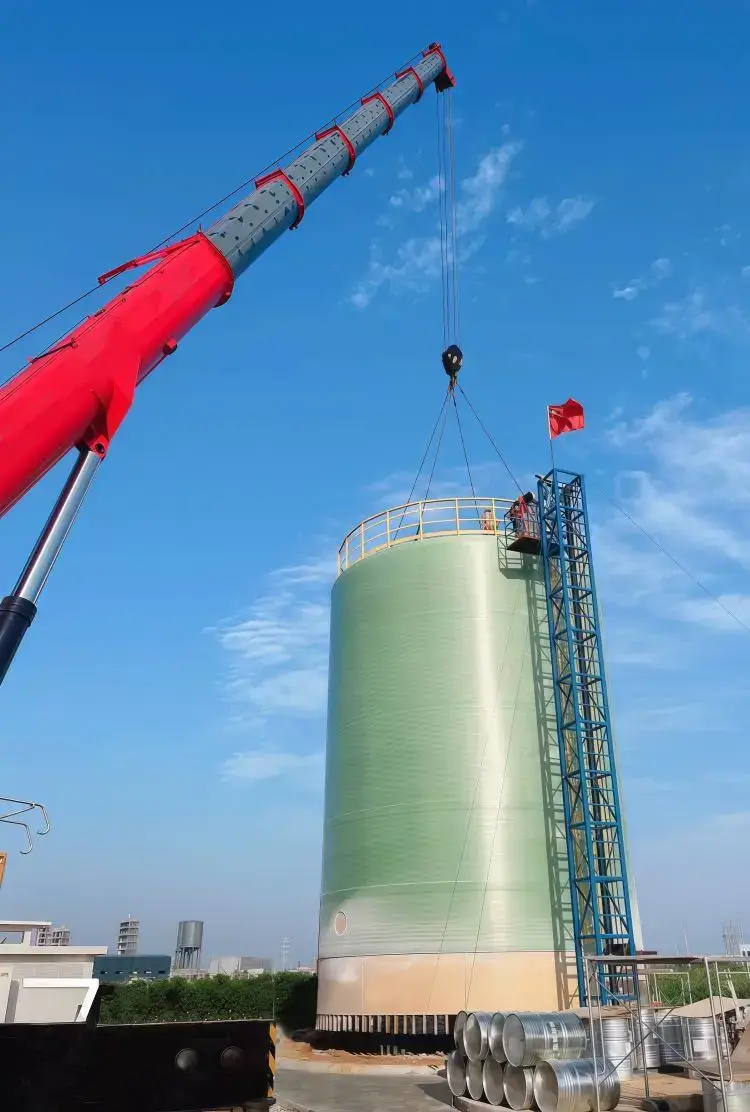
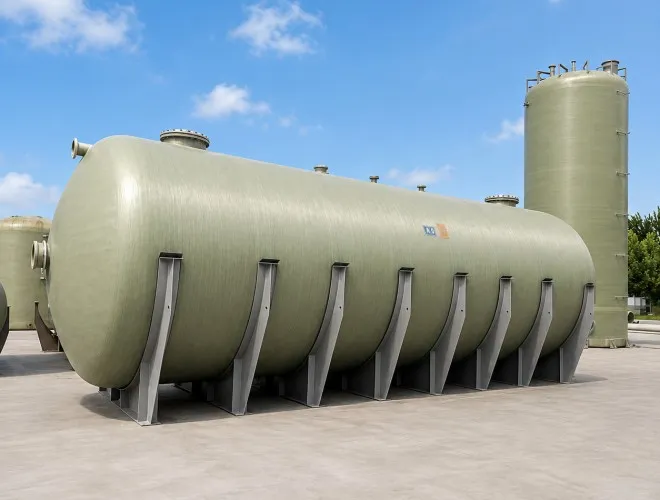
The wall of a chemical storage tank contains different functional regions.
The inner surface is primarily responsible for chemical resistance and permeation control. The structural laminate carries hydrostatic pressure and mechanical loads. The outer surface provides environmental and weather protection.
These regions perform different jobs, which means on-site fabrication must follow the designed laminate sequence rather than simply building a thicker wall.
For chemical storage applications, the liquid-contact side is one of the most important parts of the tank.
The resin system should be selected according to the actual service conditions, including:
stored chemical;
concentration;
normal operating temperature;
maximum temperature;
contaminants or impurities;
cleaning conditions.
A resin-rich surface and selected reinforcement materials can then be used to create a corrosion-resistant barrier between the stored medium and the higher-glass-content structural laminate.
If the chemical conditions are not clearly defined before fabrication begins, dimensional accuracy alone cannot make the tank suitable for the application.
Material compatibility has to be established first.
After the corrosion-resistant inner region has reached the required condition, the structural portion of the tank can be developed.
Depending on the design and fabrication method, this may involve filament winding, hand lay-up, reinforcement layers, or combinations of these techniques.
Fiber orientation is not arbitrary.
Different reinforcement directions contribute differently to circumferential and axial strength. The laminate thickness and reinforcement arrangement should therefore be based on structural requirements rather than a single standard thickness.
For a large tank, structural design may need to consider:
liquid density;
maximum liquid level;
tank diameter and height;
hydrostatic pressure;
wind loading;
seismic loading;
roof or top-mounted equipment;
ladders and platforms;
nozzle loads;
temporary lifting and construction loads.
This is why two tanks with the same nominal capacity may not use the same structural arrangement.
A wider, lower tank and a taller, narrower tank can have very different stress distributions even if they hold the same volume.
A large tank is not always manufactured as one uninterrupted laminate from beginning to end.
The bottom, cylindrical shell, roof, and other structural regions may be fabricated in different stages and later connected through designed laminate joints.
These transition areas require careful control because they must provide both sealing and structural continuity.
Surface preparation, overlap dimensions, reinforcement sequence, resin wet-out, and curing all matter at these locations.
The shell-to-bottom connection is a good example. It is exposed to hydrostatic load while also sitting at a geometric transition, so the area cannot be treated as a simple surface coating.
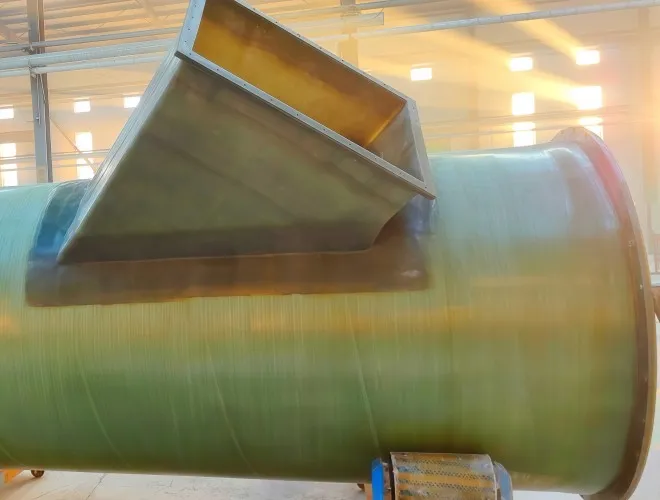
Large nozzles, manways, and other openings require similar attention.
Every opening interrupts the continuity of the original reinforcement. Local reinforcement should therefore be incorporated according to the design rather than added casually after the main shell is completed.
A large field-fabricated tank may take considerable time to complete. Waiting until the very end to check dimensions can make corrections difficult.
Dimensional control should therefore continue throughout the project.
Important measurements may include:
tank diameter;
roundness;
verticality;
overall height;
bottom level;
nozzle location;
nozzle orientation;
flange-face position;
roof geometry.
Nozzle position is particularly important because the tank eventually has to connect to external piping and process equipment.
If a nozzle is significantly out of position, the external pipework should not be forced into alignment to compensate. Doing so may create long-term mechanical loading at the FRP nozzle.
Dimensional control is therefore not only about appearance. It helps ensure that the completed tank fits naturally into the surrounding process system.
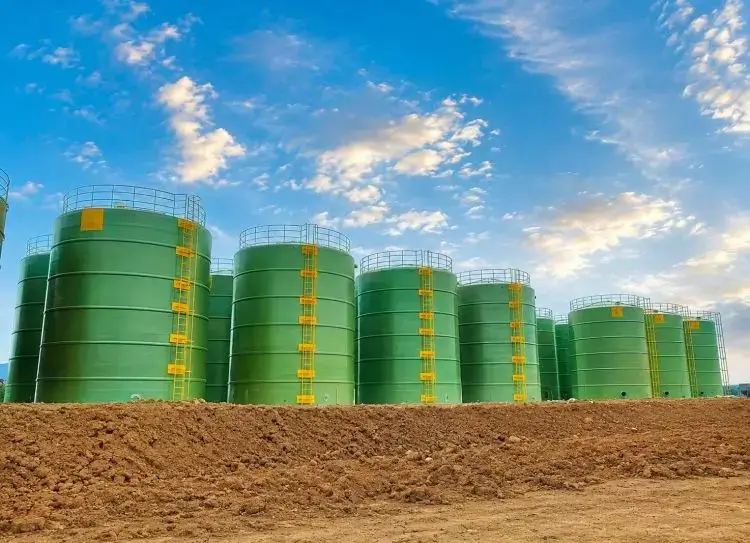
When an FRP laminate becomes hard to the touch, it does not necessarily mean that the material has reached its final chemical and mechanical properties.
The resin needs sufficient curing to develop the intended crosslinked structure.
On-site curing can be influenced by:
ambient temperature;
resin formulation;
catalyst and accelerator control;
thickness applied in one stage;
timing between laminate layers;
curing duration.
For large equipment, building too much laminate in a single operation can also create excessive exothermic heat and uneven curing.
This is why curing should be treated as part of the manufacturing process rather than an unavoidable delay between construction stages.
A schedule that saves several hours but compromises cure quality can create problems that remain with the vessel for years.
If most of the tank is manufactured at its final location, there may be little need for conventional whole-vessel lifting.
But installation still includes many important tasks.
These may include:
final positioning;
anchoring;
piping connections;
manway installation;
ladders and platforms;
vents and overflow connections;
level-instrument connections;
other project-specific accessories.
For tanks that are partially prefabricated in sections, the lifting sequence becomes even more important.
Lifting points and temporary supports should not be selected simply because they are convenient. The load condition during lifting can be very different from the load condition during normal operation.
A shell designed to resist hydrostatic pressure in service is not automatically suitable for lifting from any location.
Transportation and lifting should therefore be considered as temporary structural conditions within the overall project.
Once fabrication is complete, the vessel still needs to demonstrate that it is suitable for commissioning.
Inspection requirements vary by project, but they usually cover several levels.
The first is visual and dimensional inspection. The tank, joints, nozzles, laminate transitions, and accessories are checked for visible defects and dimensional compliance.
The next stage may include verification of cure condition and examination of critical laminate areas.
Finally, the project may require leak testing, hydrostatic filling, or other commissioning checks.
For a large tank, filling is normally better treated as a controlled process rather than a rapid one-time operation.
As the liquid level rises, inspectors can observe:
the bottom and shell for leakage;
nozzle areas for abnormal behavior;
tank deformation;
foundation response;
anchoring condition.
This stage is not only about determining whether water leaks out.
It also helps confirm that the vessel, foundation, nozzles, anchors, and supporting structures behave together as intended under actual liquid load.
Large-tank projects do not always have to choose between “all factory-made” and “all site-made.”
A hybrid approach is often more practical.
Some components can be manufactured and inspected under factory conditions, while the major shell, bottom, or final structural connections are completed on site.
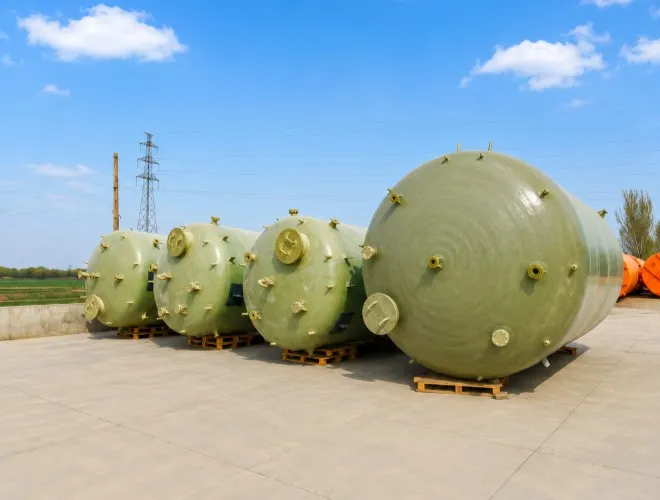
Factory-prefabricated items may include certain:
flanges;
nozzles;
fittings;
access components;
reinforcement details;
auxiliary assemblies.
This approach can combine the repeatability of factory production with the dimensional freedom of field fabrication.
The important question is not what percentage is manufactured at each location.
The important point is to define in advance:
what will be fabricated where, how it will be transported, how it will be positioned, how it will be joined, and how each stage will be inspected.
With smaller equipment, it may be tempting to judge quality mainly from the finished product.
That approach is not enough for a large field-fabricated FRP vessel.
Many critical features are covered by later laminate layers and cannot be fully inspected from the outside once construction is complete.
Quality control therefore needs to follow the fabrication sequence.
A typical project logic can be viewed as:
Material verification → Foundation inspection → Environmental control → Corrosion-barrier fabrication → Structural laminate construction → Nozzles and local reinforcement → Curing → Dimensional inspection → Accessories → Final inspection
Each stage depends on the quality of the stage before it.
If surface preparation is poor, the next laminate does not erase that problem. If dimensional control is lost early, the final nozzle positions become more difficult to correct. If curing is incomplete, later layers can inherit the weakness.
This is one of the main differences between field fabrication and ordinary equipment installation:
the project site temporarily becomes part of the manufacturing facility.
For large chemical-storage, water-treatment, metallurgical, mining, and other industrial projects, the purpose of field fabrication is not simply to make a bigger tank.
It is to overcome transportation limitations without losing control of the material system, structural design, and fabrication quality.
For Yingnai large-tank projects, the field-fabrication plan can be developed around the stored medium, required capacity, vessel dimensions, project location, transportation limits, foundation, nozzle arrangement, wind and seismic requirements, and available installation space.
A large site-built FRP vessel is therefore far more than a shell made by repeatedly applying resin and glass reinforcement.
Foundation inspection, corrosion-barrier construction, structural fabrication, nozzle reinforcement, curing, dimensional control, installation, and commissioning all contribute to the final result.
The tank is not truly complete when the last layer of reinforcement has been applied.
It is complete when the materials, structure, foundation, connections, and installation conditions have all been brought together according to the same engineering basis.
For projects that require customized large composite storage equipment, an experienced FRP tank manufacturer should be able to consider fabrication strategy and site conditions as part of the tank design rather than treating installation as a separate issue after manufacturing.

 English