Wastewater piping may appear simpler than chemical process piping. One end collects liquid, and the other delivers it to a treatment plant, equalization tank, or discharge point. In real industrial facilities, however, the word “wastewater” can describe an enormous range of fluids.
Municipal sewage, chemical wastewater, electroplating effluent, mining water, metallurgical wastewater, flue-gas desulfurization wastewater, pharmaceutical effluent, and food-processing discharge may differ greatly in pH, dissolved salts, suspended solids, temperature, and chemical aggressiveness.
For this reason, selecting an FRP pipe for wastewater service should not begin with pipe diameter alone.
A more reliable approach is to first understand what will flow through the pipe, how it will flow, where the pipe will be installed, and what loads it will experience over time. Only then should resin system, pipe construction, pressure class, stiffness, joints, and installation method be finalized.
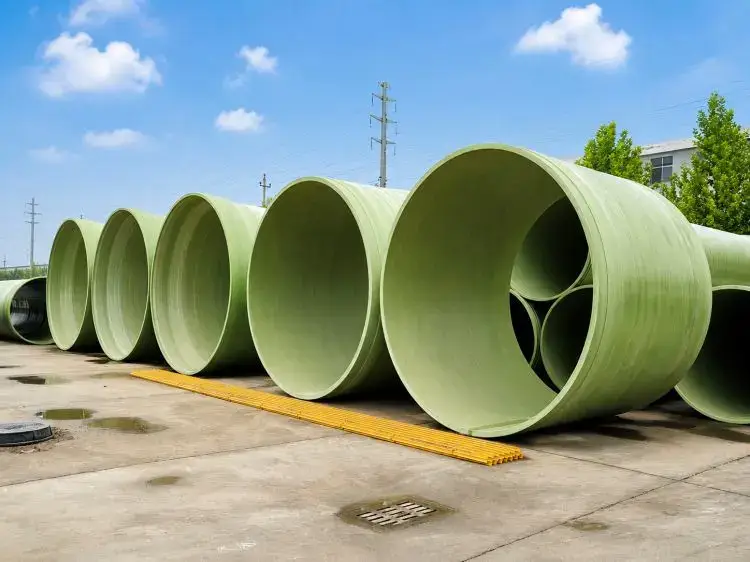
Domestic and municipal sewage can be chemically complex, but its characteristics are often more predictable than those of industrial wastewater.
Industrial effluent is different because its composition is closely linked to the production process.
For example:
metal-finishing wastewater may contain acids, alkalis, and metal ions;
chemical-process effluent may contain salts, organics, or residual solvents;
mining and metallurgical wastewater may carry abrasive mineral particles;
desulfurization wastewater may contain high concentrations of chlorides and dissolved salts;
some production discharges may experience periodic temperature or concentration spikes.
This means that the first question should not be:
“What pipe diameter do we need?”
It should be:
“What exactly is in the wastewater?”
At minimum, the design basis should identify:
major chemical components and possible mixtures;
pH and expected pH range;
chloride, sulfate, or other relevant salt concentrations;
normal and maximum temperature;
suspended solids and particle characteristics;
possible oils, solvents, oxidizing chemicals, or other contaminants.
If several production areas discharge into one header, the mixed wastewater should be evaluated as a combined service condition rather than by looking at only one branch line.
The corrosion resistance of FRP is not a fixed property that applies equally to every environment.
The long-term performance of the wetted surface depends heavily on the resin system and internal corrosion-resistant laminate.
A wastewater stream containing ordinary dissolved salts may not require the same resin system as one containing strong oxidizers, solvents, highly acidic components, or elevated temperatures.
Material selection should therefore consider three conditions together:
chemical composition + concentration + temperature
A change in any one of these can affect the suitability of the original material choice.
For industrial wastewater with variable composition, the design should pay particular attention to the most severe credible condition, rather than relying only on average operating data.
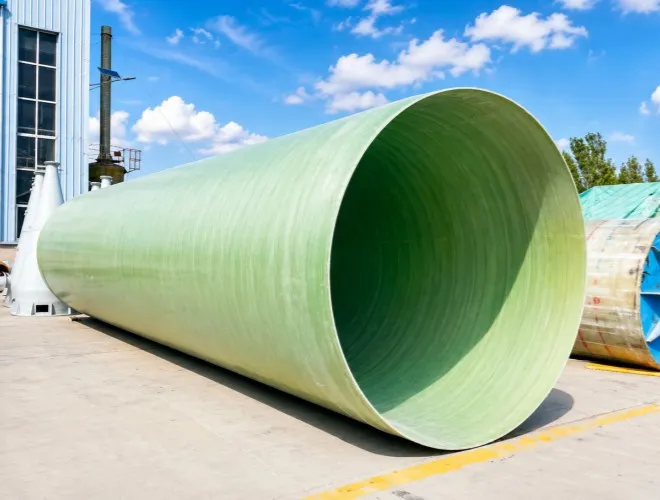
In an FRP wastewater pipe, the inner region and structural region do not perform exactly the same function.
The liquid-contact surface is primarily intended to resist chemical attack and reduce permeation. The structural laminate carries pressure and mechanical loads, while the external surface protects the pipe from installation damage and the surrounding environment.
This means that increasing total wall thickness alone does not automatically solve a corrosion problem.
Two pipes with the same outside diameter and total wall thickness may still have different service capabilities if they use different:
resin systems;
corrosion-resistant inner layers;
reinforcement arrangements;
structural constructions.
For wastewater service, the internal laminate should be selected around the chemistry, while the structural portion should be designed around pressure, stiffness, span, and other loads.
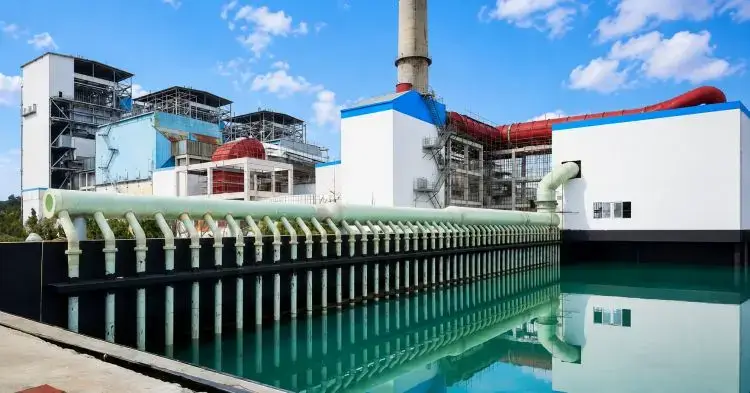
Corrosion usually receives most of the attention in wastewater projects. Abrasion often receives less.
If the effluent contains sand, mineral particles, crystals, sludge, or other hard solids, those particles can continuously interact with the pipe wall.
In a straight pipe, wear may be relatively distributed. At elbows, tees, reducers, and other locations where flow direction changes, particle impact can become more concentrated.
For wastewater containing significant solids, confirming resin compatibility is therefore only part of the selection process.
The designer should also understand:
solids concentration;
approximate particle size;
particle hardness;
flow velocity;
tendency to settle;
frequency of flushing, start-up, and shutdown.
Where abrasion is significant, the pipe system may require an enhanced wear-resistant inner layer, a specialized liner, or changes to local geometry and flow velocity.
There is no single “best velocity” for every wastewater system.
Excessive velocity can increase erosion and hydraulic loss, while very low velocity can allow solids to settle. The appropriate range depends on the fluid, particle loading, diameter, and operating pattern.
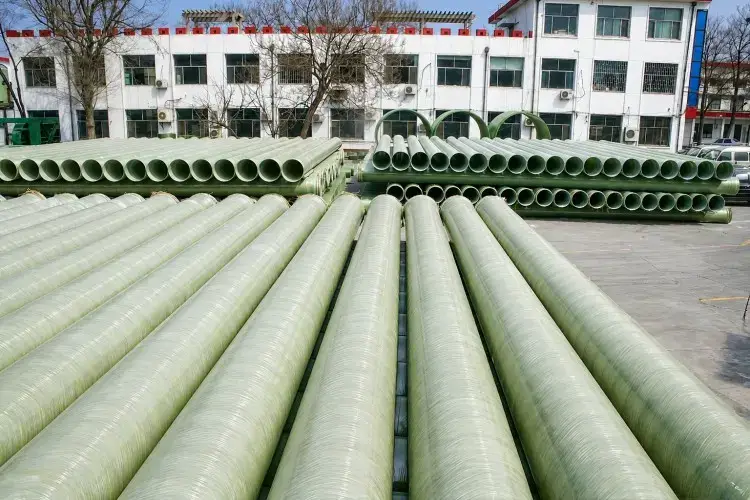
Pipe sizing normally involves more than checking whether the present flow rate can pass through the line.
The design should balance:
flow capacity, velocity, pressure loss, solids-settling risk, and future operating demand.
If a plant is expected to expand in several years, sizing a line only for the current flow may lead to early replacement.
On the other hand, simply increasing the diameter “for safety” is not always better. In wastewater containing suspended solids, an oversized pipe can reduce flow velocity and increase sediment accumulation.
For pumped systems, the pipe and pump should also be evaluated together.
Pipe diameter affects system resistance, while system resistance affects pump operating point, energy use, and actual flow. Treating the pump and pipeline as two independent selections can lead to poor system performance.
This is one of the most important distinctions in wastewater piping.
Two pipelines may both transport wastewater, but a pumped pressure line and a gravity sewer do not have the same structural requirements.
Where pumps are used, the pipe system should consider:
normal operating pressure;
maximum pressure;
pump start and stop conditions;
valve operation;
pressure surges;
water hammer or other transient events.
The required pipe rating should not be selected only from the pump's nominal discharge pressure.
Transient conditions can create pressures above normal operation, especially in long pipelines or systems with rapid valve closure.
A gravity line may operate with very little internal pressure, but that does not mean structural design is unimportant.
For buried pipe, external loads can become the controlling factor.
These may include:
soil load;
groundwater;
vehicle load;
burial depth;
compaction conditions.
In these systems, ring stiffness and resistance to external deformation may be more important than internal pressure capacity.
This leads to an important distinction:
Pressure rating does not replace stiffness design, and stiffness classification does not replace pressure design.
They address different structural demands.
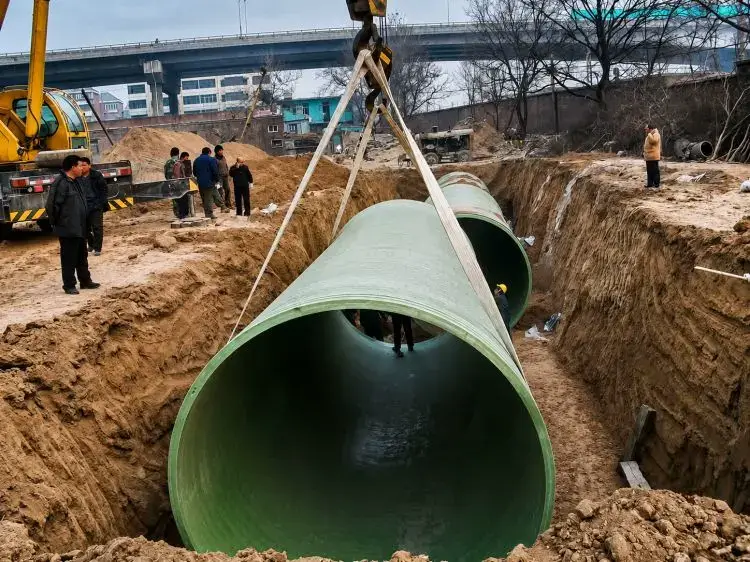
A large proportion of wastewater pipelines are installed underground.
For flexible composite pipe, the soil surrounding the pipe is not merely backfill. It forms part of the pipe-soil structural system.
Buried-pipe design should therefore consider:
burial depth;
groundwater level;
native soil conditions;
trench width;
bedding;
backfill material;
compaction;
surface traffic and vehicle loads.
Poor installation can undermine the performance of otherwise suitable pipe.
For example, insufficient side compaction can reduce lateral support, while hard points beneath the pipe can create concentrated loading. Uneven bedding can also produce deformation that was never intended in the pipe design.
For buried wastewater projects, purchasing the correct pipe is only one part of the job.
Installation quality is part of the structural design.
Industrial wastewater lines are also frequently installed above ground, especially inside process plants.
Above-ground systems introduce a different set of concerns.
Support spacing, fitting weight, valve weight, thermal expansion, and equipment-interface loads become more visible and more important.
If support spacing is too large, long FRP pipe sections may experience excessive deflection.
Heavy metallic valves or accessories should not simply hang from the composite pipeline unless the system has been designed for those loads.
Temperature changes can also produce axial movement. Fixed points, guides, and sliding supports should be arranged so that expansion and contraction are managed by the piping system rather than being transferred unintentionally into one flange, nozzle, or joint.
Support design is therefore not an afterthought. It is part of selecting the complete piping system.
Common FRP wastewater-piping connections may include flanges, socket joints, couplings, and field-laminated joints.
Each has a different role.
Flanges are useful around valves, equipment, and locations that may require future disassembly.
Socket or coupling systems can be efficient for long, repetitive runs when they are designed as part of a compatible piping system.
Field-laminated joints can provide flexibility for large diameters, custom fittings, or pipe sections that require final adjustment at site.
The joint should not be chosen only because one method appears easier to install.
The design should also consider:
pressure thrust;
axial restraint;
allowable movement;
maintenance requirements;
working space;
field temperature and humidity;
installation quality control.
For pressure wastewater lines, it is particularly important to understand whether the selected joint can transfer axial forces and how thrust at elbows, tees, reducers, and closed ends will be controlled.
Problems in wastewater systems are often concentrated where the flow changes direction or velocity.
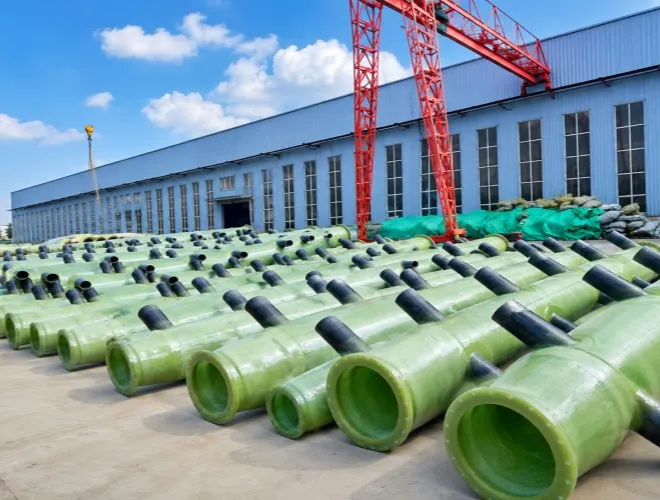
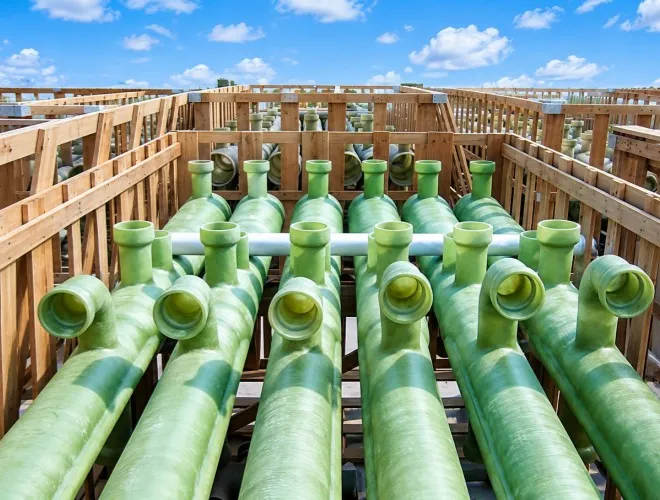
Elbows redirect the flow. Tees split or combine streams. Reducers change velocity and pressure distribution.
If the wastewater contains abrasive particles, these fittings can also become locations of concentrated wear.
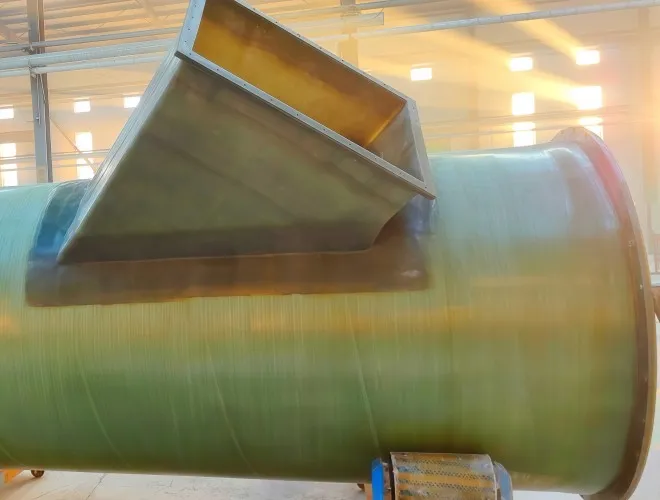
FRP fittings should therefore be evaluated for more than nominal diameter.
Important considerations include:
structural strength;
chemical resistance of the wetted surface;
local abrasion;
joint arrangement;
supports and external loads.
The straight pipe and fittings should preferably be selected using the same process data, pressure basis, resin system, and service assumptions.
Designing the pipe first and leaving elbows and tees to be “solved later” at the site creates unnecessary risk.
One characteristic separates many wastewater systems from stable process lines:
the operating conditions can change significantly over time.
Flow may vary between day and night. Different production batches may create different wastewater chemistry. Cleaning operations may introduce temporary temperature or concentration peaks.
For this reason, average operating conditions are not enough.
The design should also identify:
maximum flow;
maximum temperature;
minimum and maximum pH;
short-term high-concentration discharge;
abnormal chemical carryover;
frequency of system start and stop.
Average conditions describe everyday operation.
Extreme conditions often determine whether the selected pipe material and structure remain safe.
A request that includes only pipe diameter and total length rarely provides enough information for a meaningful technical selection.
A better project inquiry should include the service data needed to evaluate both material compatibility and structural requirements.
Useful information includes:
source and composition of the wastewater;
concentration and pH range;
normal and maximum temperature;
solids content and particle characteristics;
design and maximum flow;
normal and maximum pressure;
possible vacuum conditions;
pipe diameter and approximate total length;
above-ground or buried installation;
burial depth or support arrangement;
main elbows, tees, valves, and equipment connections;
preferred joint type, if already specified;
project location and applicable engineering requirements.
The more complete this information is, the easier it becomes to select resin, corrosion barrier, structural laminate, pressure rating, stiffness, and joint configuration around the real operating conditions.
Choosing wastewater pipe should not end with the question:
“Will this wastewater corrode FRP?”
A useful selection process has several layers.
First, understand the wastewater chemistry.
Then determine the hydraulic conditions.
Next, identify whether the pipe will be buried or above ground and what structural loads it must carry.
Finally, evaluate the pipe, fittings, joints, supports, and installation method as one connected system.
For Yingnai wastewater and industrial-effluent piping projects, selection can be based on the chemical composition, temperature, flow, pressure, solids loading, installation method, and piping layout of the actual project.
Municipal sewage, low-salinity industrial wastewater, highly corrosive chemical effluent, and abrasive mineral-bearing wastewater should not all be approached with one default pipe construction.
A reliable wastewater pipeline is not created simply by choosing a “corrosion-resistant material.”
It is created when material compatibility, structural design, hydraulic conditions, fittings, joints, and field installation are matched to the same operating environment from the beginning.
That is the more useful way to select an FRP pipe for long-term wastewater and industrial effluent service.

 English