Once an FRP storage tank enters service, maintenance should not begin only after a leak appears. Many conditions that eventually lead to leakage or structural concerns often show themselves much earlier through surface changes, nozzle movement, foundation settlement, localized cracking, or unusual deformation.
For this reason, FRP tank inspection is better understood as an ongoing condition-monitoring process rather than an occasional search for visible damage.
For plant operators, the goal is not to perform complex composite-material analysis. The practical goal is to know which areas deserve regular attention, which changes should be recorded, and which findings require a more detailed engineering assessment.
Inspection intervals should not be copied blindly from one tank to another. Chemical service, temperature, concentration, operating history, tank age, installation environment, and previous repairs all influence how often a tank should be checked and where attention should be focused.
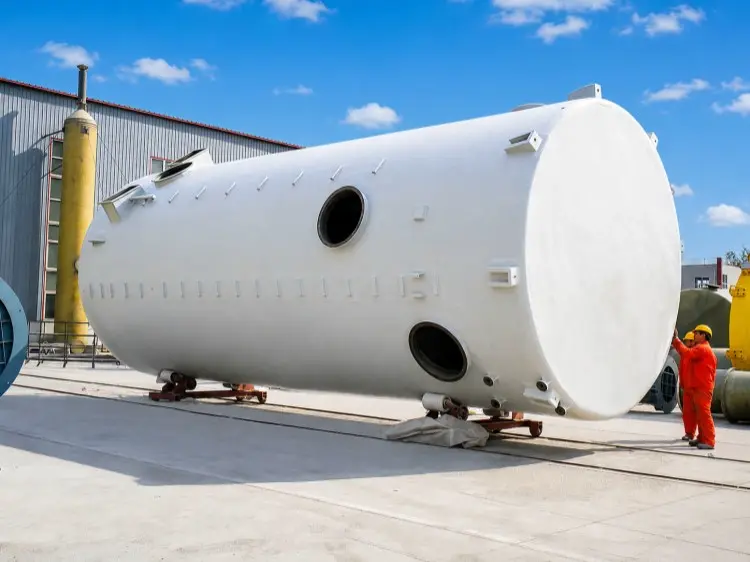
A routine walk-around does not require opening the tank or performing sophisticated testing.
It should, however, involve more than checking whether liquid is visibly leaking from the shell.
A more useful approach is to become familiar with the normal condition of the tank and look for anything that has changed since the previous inspection.
Operators can pay attention to:
new cracks, bulges, or unusual deformation;
discoloration, chalking, or localized surface damage;
signs of leakage around nozzles, flanges, or manways;
unexplained liquid around the foundation;
external piping pulling or pushing on tank nozzles;
movement, corrosion, or loosening of anchors and supports;
blocked vents or overflow connections.
One principle is especially useful:
Do not look only at how severe something appears. Look at whether it is new, changing, or spreading.
A surface color variation that has remained unchanged for years means something very different from a crack that appeared recently and continues to grow.
Problems do not always begin on the large, flat areas of the shell.
Nozzles, flanges, manways, and other geometric transitions often deserve closer attention because they must maintain sealing while also dealing with loads from connected piping, valves, supports, and installation alignment.
During inspection, operators can look for:
radial or circumferential cracking;
signs of seepage;
obvious flange misalignment;
nozzle sagging or displacement;
external piping continuously pulling the nozzle upward, downward, or sideways.
A heavy metallic pipe or valve should not be allowed to rely primarily on the FRP nozzle for support.
Even if no leakage is visible, long-term external loading can create local stress concentrations.
External piping should have adequate independent support so that the tank connection performs mainly as a process connection rather than as a structural hanger.
Large FRP tanks depend heavily on stable support.
Foundation settlement, localized low spots, changes in bedding, or long-term water accumulation can alter the way the bottom and lower shell carry load.
These problems may not produce an immediate crack or leak. Instead, the tank can slowly experience redistribution of stress over time.
Routine checks can include:
new tank inclination;
cracking or settlement around the foundation perimeter;
standing water around the tank base;
movement around anchor locations;
visible changes in the way the bottom is supported.
If a tank that has been stable for years begins to lean or settle, the inspection should not focus only on the shell. The foundation and surrounding support conditions should be reviewed at the same time.
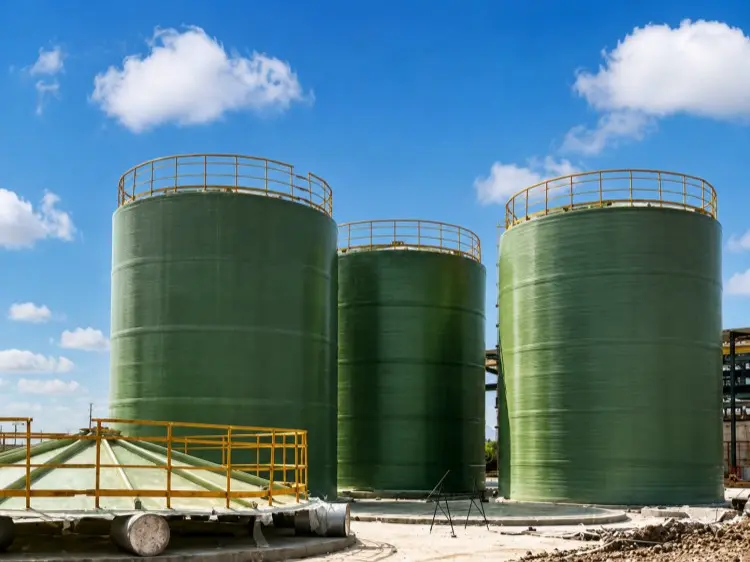
Outdoor FRP tanks are continuously exposed to sunlight, rain, temperature cycling, and industrial atmosphere.
Over time, the exterior may lose gloss, fade, chalk, or show other signs of weathering.
These changes indicate aging of the outer protective surface, but they do not by themselves prove that the structural laminate has failed.
It is useful to distinguish between two types of change.
Minor fading, loss of gloss, or light chalking often begins in the external protective layer.
Closer attention is appropriate when weathering is accompanied by:
exposed glass reinforcement;
deep cracking;
delamination;
large blisters;
noticeable structural deformation;
impact damage extending into the laminate.
The key is not to treat every color change as a reason for replacement.
Instead, evaluate the depth, extent, location, and progression of the change.
For a chemical storage tank, the internal corrosion-resistant surface is the area that remains in direct contact with the process medium.
Planned internal inspection can therefore reveal conditions that are not visible from the outside.
Before anyone enters the tank, however, the tank must be treated as a potential confined space.
An empty vessel is not automatically a safe vessel.
Internal inspection should follow the plant's procedures for isolation, draining, cleaning, ventilation, atmospheric testing, entry permits, and personnel protection.
Once safe entry conditions have been established, the internal surface can be examined for:
unusual roughness;
blistering;
softening;
cracking;
localized chemical attack;
abnormal conditions around nozzle roots;
erosion or deposition on the bottom.
Minor color change and significant resin softening are not equivalent findings.
If the inner surface shows widespread blistering, delamination, deep cracking, or substantial loss of hardness, the condition should be evaluated further rather than simply coated over.
The bottom of a chemical tank can experience a different environment from the vertical shell.
If the stored liquid contains solids, crystals, or sediment, deposits may accumulate over time. Agitation, draining, or high-velocity inlet flow may also create localized erosion.
During planned internal inspection, useful areas to check include:
wear near drain outlets;
erosion below inlet streams;
persistent deposits that are difficult to remove;
cracking around the shell-to-bottom transition.
For tanks equipped with mixers, vibration and changing flow patterns may also alter the location and severity of wear.
The inspection should therefore consider not only corrosion, but also the mechanical effects of the way the liquid moves inside the tank.
Some storage-tank problems are caused not by the laminate itself, but by unexpected pressure conditions.
If a vent becomes blocked, rapid filling can create positive internal pressure. Rapid draining can create vacuum.
An atmospheric tank should not be assumed to tolerate unlimited pressure or vacuum simply because it normally operates near atmospheric conditions.
Operators should periodically confirm that:
vents remain open and unobstructed;
filters or flame-arresting devices are not restricting airflow;
overflow lines remain clear;
filling and draining rates have not changed significantly without review.
If the process is modified with a larger pump or higher transfer rate, the venting arrangement should also be reconsidered.
A change that appears to be purely operational can change the actual mechanical loading on the tank.
Ladders, platforms, handrails, instruments, valves, and other accessories are part of the tank system.
As equipment ages, corrosion of metal components, loose supports, or later modifications can introduce new loads into the FRP structure.
Routine checks can include:
loosened ladder or platform attachments;
corroded metal parts creating sharp contact points;
later-added equipment without independent support;
instrumentation or piping pulling on nozzles because of thermal movement.
One common long-term issue is gradual addition of equipment around the tank while the original structure is never reassessed for those loads.
Part of good FRP tank maintenance is identifying those changes before they become structural problems.
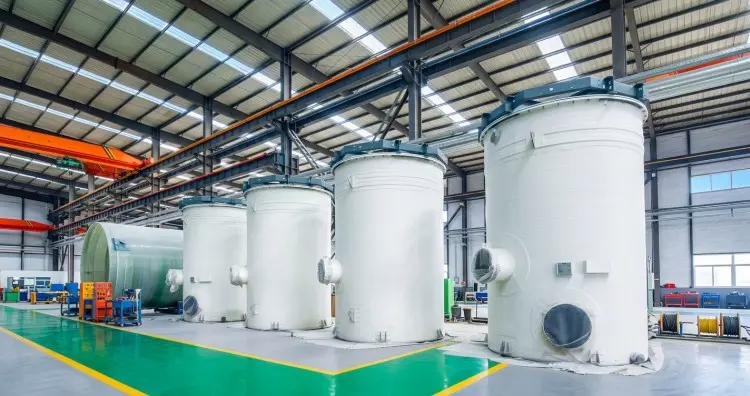
If every inspection report simply says “normal,” useful information is lost.
The real value of inspection comes from comparing condition over time.
For important areas, operators can use repeatable photographs from the same angles and record changes such as:
whether a crack is growing;
whether a blistered area is expanding;
whether a nozzle has moved;
whether foundation settlement is continuing;
whether leakage repeatedly returns to the same location.
Three years of comparable photographs can reveal far more than one isolated inspection.
For older tanks, it is also useful to maintain a tank history that includes:
original design conditions;
changes in stored chemicals;
temperature changes;
repairs;
abnormal operating events;
previous inspection findings.
This history can be extremely valuable when deciding whether a new condition is stable, progressive, or related to a past event.
Plant operators are well positioned to detect changes, but they should not be expected to determine remaining structural capacity from visual observations alone.
Further evaluation is appropriate when conditions such as the following are found:
persistent or recurring leakage;
deep or extensive cracking;
widespread blistering or delamination;
obvious material softening;
major nozzle distortion;
new and significant tank settlement or inclination;
impact, overheating, overpressure, or abnormal vacuum events;
chemical concentration or temperature exceeding the original design conditions.
Additional assessment may involve visual examination, hardness testing, thickness evaluation, localized material examination, or other methods suitable for composite equipment.
No single test should be treated as a universal answer.
For example, hardness can provide useful information about material condition, but it does not by itself prove that the entire tank is structurally sound.
FRP equipment can often be repaired in the field, but repair should begin by understanding why the damage occurred.
If a nozzle repeatedly cracks because external piping places continuous load on it, repairing the crack without correcting the support arrangement may only reset the clock until the same problem returns.
Likewise, if an internal surface is being attacked by an incompatible chemical, simply adding another layer of resin may not solve the real problem.
A more useful repair sequence is:
Damage type → Extent → Cause → Original material and structure → Repair method → Cure → Reinspection
Repair materials should also be compatible with both the original tank construction and the actual chemical service.
Using an unidentified resin simply because it is available on site can create a new compatibility problem.
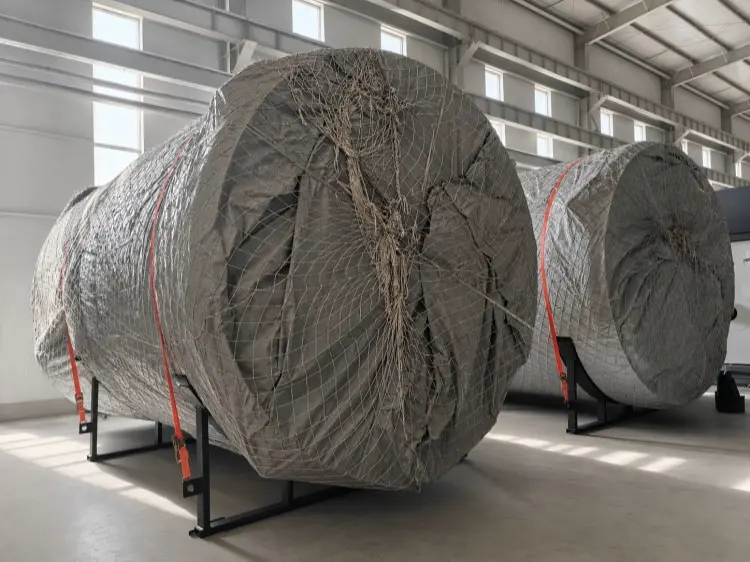
Not every FRP tank needs the same inspection interval.
A tank storing a relatively mild liquid indoors at moderate temperature should not necessarily follow the same inspection strategy as an older outdoor vessel holding a hot, highly corrosive chemical.
Inspection frequency can be adjusted according to:
chemical aggressiveness;
operating temperature;
equipment age;
continuous or intermittent operation;
previous abnormal findings;
outdoor exposure;
plant maintenance and safety requirements.
External walk-around inspections can be performed relatively frequently.
Internal inspections that require draining, cleaning, isolation, and confined-space entry are usually better coordinated with shutdown planning and risk level.
The goal is not to force every tank into the same schedule.
The goal is to make inspection frequency proportional to the actual service risk.
Effective maintenance does not require plant operators to become composite-material specialists.
The most important skill is familiarity with the normal condition of the equipment and consistent attention to the locations most likely to change:
internal and external surfaces, nozzles, flanges, foundation, supports, venting, and accessories.
Specialist evaluation becomes important when a change needs to be interpreted in terms of depth, cause, or structural significance.
For Yingnai tank projects, inspection and maintenance should always return to the original service basis: what chemical is stored, at what concentration and temperature, what loads the tank was designed to carry, and whether those conditions have changed during operation.
The same principle applies to any FRP chemical tank.
Good maintenance is not simply finding the crack after the tank starts leaking.
It is building enough inspection history to recognize a small change before it becomes a large problem.

 English